Material authored by: Jaroslav Valůch & Jan Patawa
Measure the baseline, or you will never prove you moved
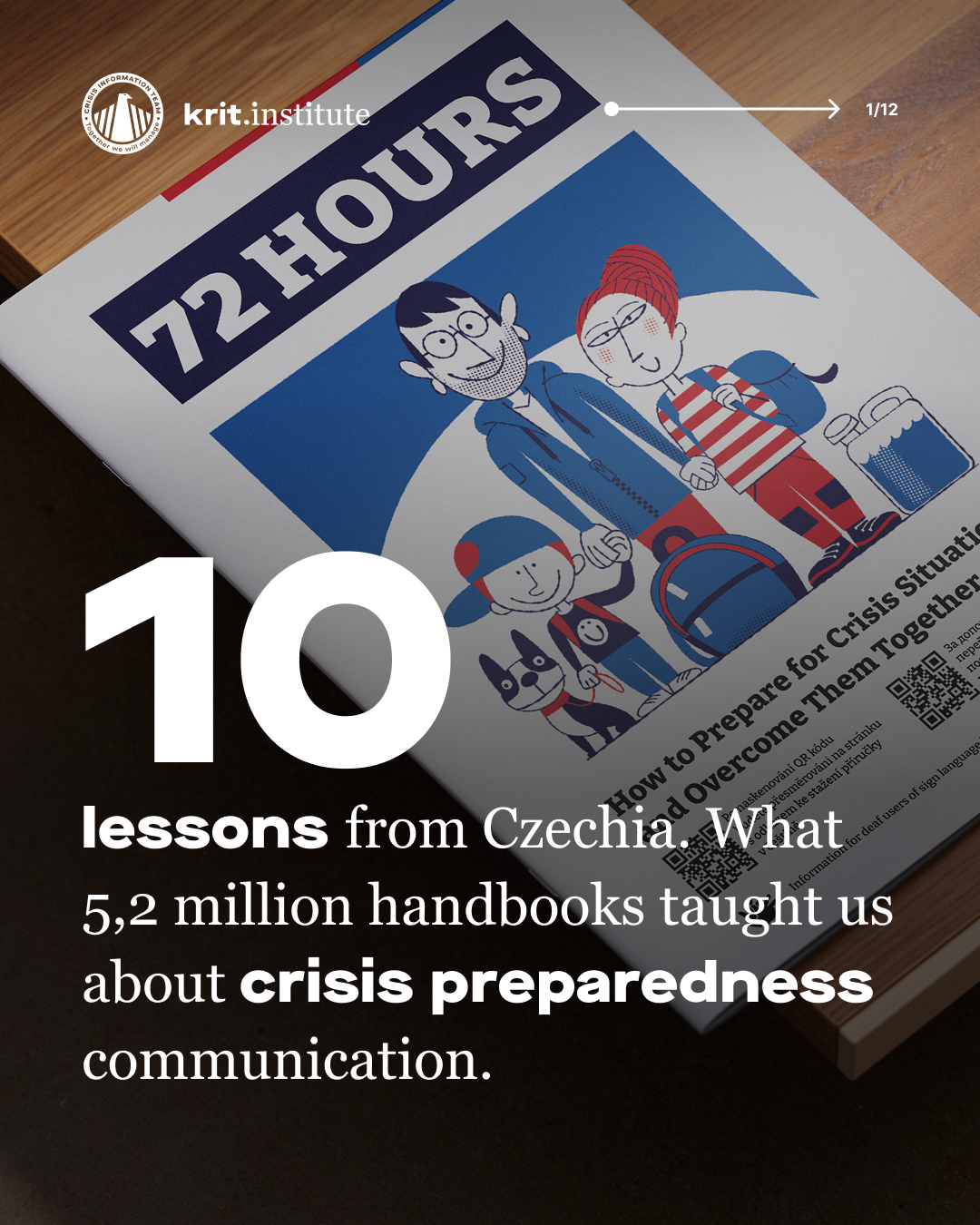
Thinking about a public preparedness campaign? You will face dilemmas, and public perception polling is what helps you resolve them. Here is how Czechia did it, where the Ministry of the Interior, hand in hand with the fire and rescue services, mailed the 72 Hours handbook to every household, the largest state preparedness effort in the country's modern history.
The 72 Hours handbook project was built on data: before, during, and after. What follows is the story in three parts, where we started, how we designed it, and what actually changed, with the lessons that travel to any country attempting the same.
Where we started
A crisis exposed the gap, as it always does
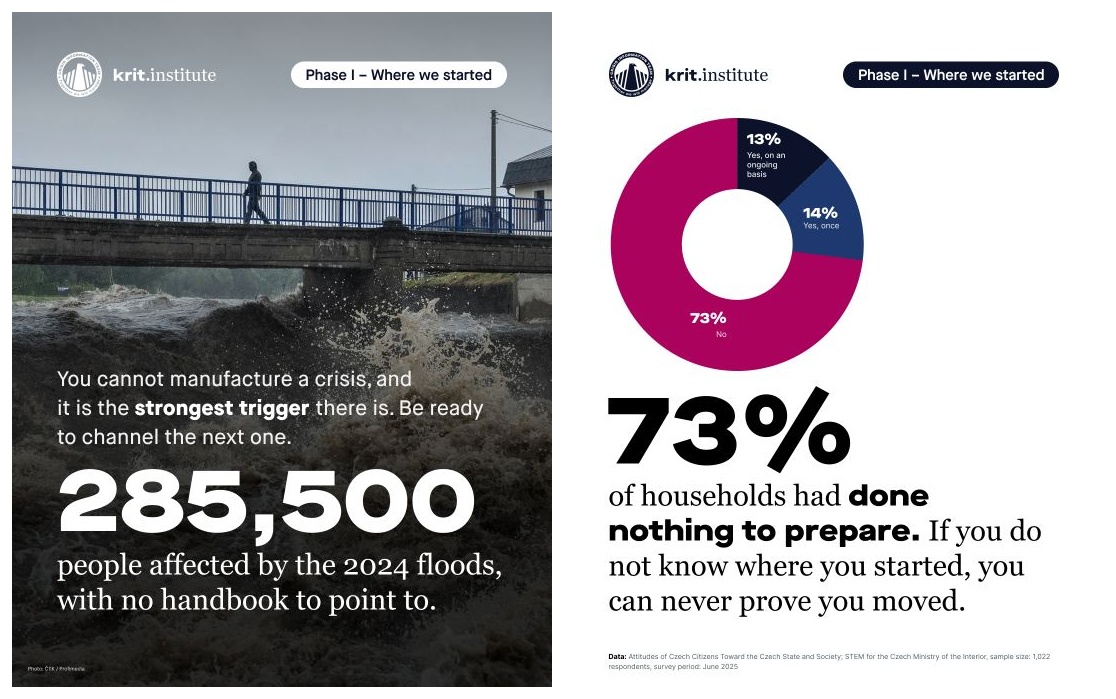
In September 2024, floods hit with days of advance warning. But there was nowhere to point people: no handbook, no preparedness culture, no agreed advice. 285,500 people were affected. Many waited, did not prepare, or refused to evacuate. A crisis is the most powerful trigger for preparedness there is, and we had nothing ready to channel it. That was the moment the project became unavoidable.
Know the ground you are standing on
Every dilemma we faced traces back to four starting conditions, and naming them will save you from copying a model that does not fit. Communist-era civil defense had left preparedness feeling absurd. Trust in government was among the lowest in the EU. The rescue services are so effective and trusted that citizens assume someone will always come and take care of everything. And the country had never distributed a preparedness handbook, not once. Your own list will differ, but you need it before you design anything.
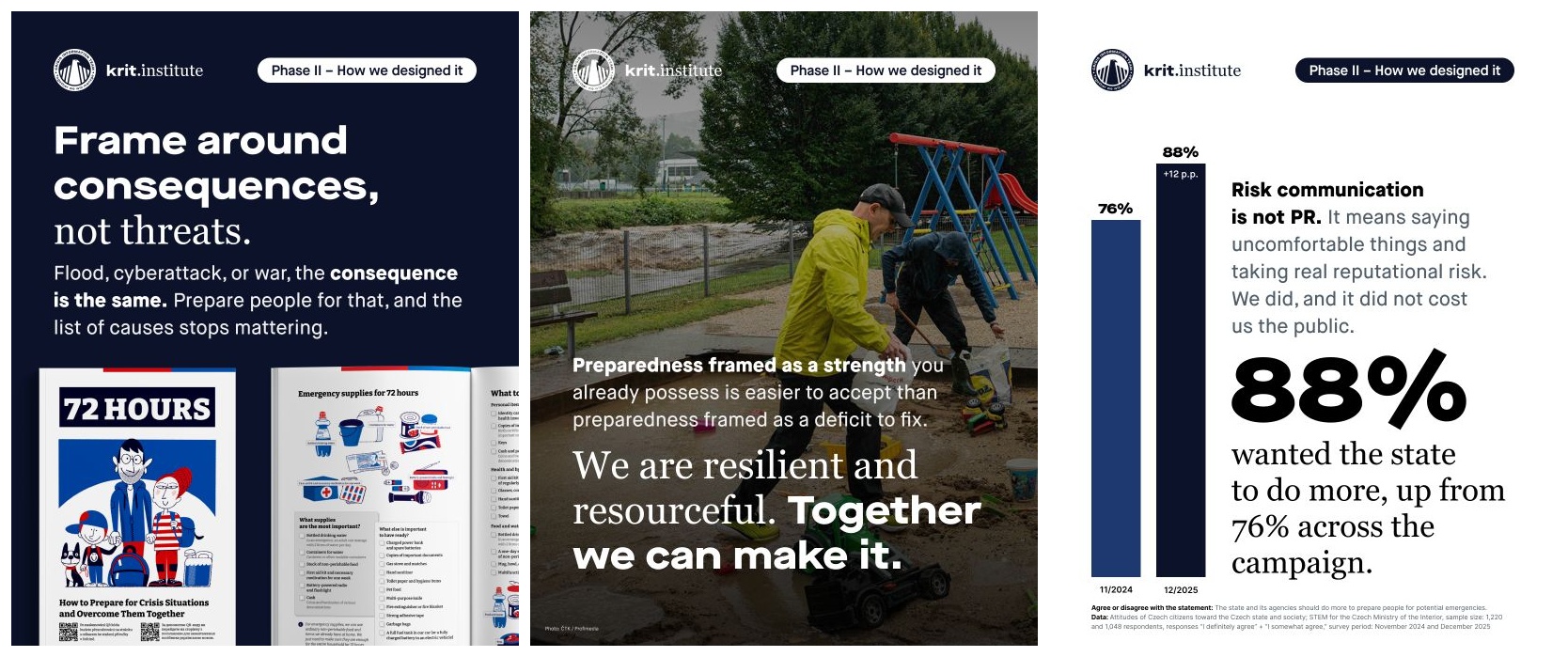
Before launch, we knew exactly where we stood: 73% of households had taken no steps to prepare, and only 22% knew what supplies to keep, 17% what to pack in an evacuation bag, 12% where to shelter. Yet 88% agreed the state should do more to help prepare citizens, even amid that low trust. People wanted practical guidance, and they wanted it from the state. Those numbers became the yardstick for everything that followed.
How we designed it
Inspiration is not enough. Do your homework, then build your own
We gathered what was available internationally and took from each what we needed, consulting intensively with colleagues in Finland and Sweden. From Finland, we took the consequences-based approach and focus on civil contingencies; from Sweden, an 80-year handbook tradition and the discipline of before-and-after surveys that shaped our own research design. A foreign model points a direction. Only your own baseline tells you whether you moved.
Frame around consequences, not threats
Build the handbook around a list of threats, and it balloons to 200 pages, with endless arguments about what to include. Framing around consequences solves this elegantly. It does not matter whether the water stops because of a flood, a cyberattack, or a war: the consequence is the same. You prepare people for the loss of water, power, heat, and communication, and the list of causes stops mattering.
Hard dilemmas often have an elegant answer
Every campaign throws up dilemmas. One of ours was whether to name war, as Sweden did on its cover. The consequences framing dissolved it: war is just one more cause leading to outcomes we already cover. We chose to start with the civilian crises people know from experience, floods and blackouts, and build the foundation of a preparedness culture first. War preparedness belongs to the Armed Forces. Look for the framing choice that makes several dilemmas disappear at once.
Build on the resilience people already have
The strongest framing does not ask people to become someone new. It reminds them of who they already are. We borrowed this from Sweden too: build the handbook on the grit and solidarity a society shows every time things get hard, rather than on fear of what might go wrong. Our handbook frames it plainly: "Preparedness is the foundation. But most importantly, in difficult times, we can help each other. When things are at their worst, we stand together. We are resilient and resourceful. Together we can make it." Preparedness framed as a strength you already possess is far easier to accept than preparedness framed as a deficit to fix.
It is not PR
It is easy to assume a state campaign is wasted on a public that distrusts the government. It is not. Even where trust is low, this communication is necessary, and it is not just the PR. Risk communication is not about chasing a positive image and easy wins. It means saying uncomfortable things, including messages where you can expect pushback and a degree of reputational risk. You demonstrate competence by addressing the hard topics, not by avoiding them.
Do not call it survival
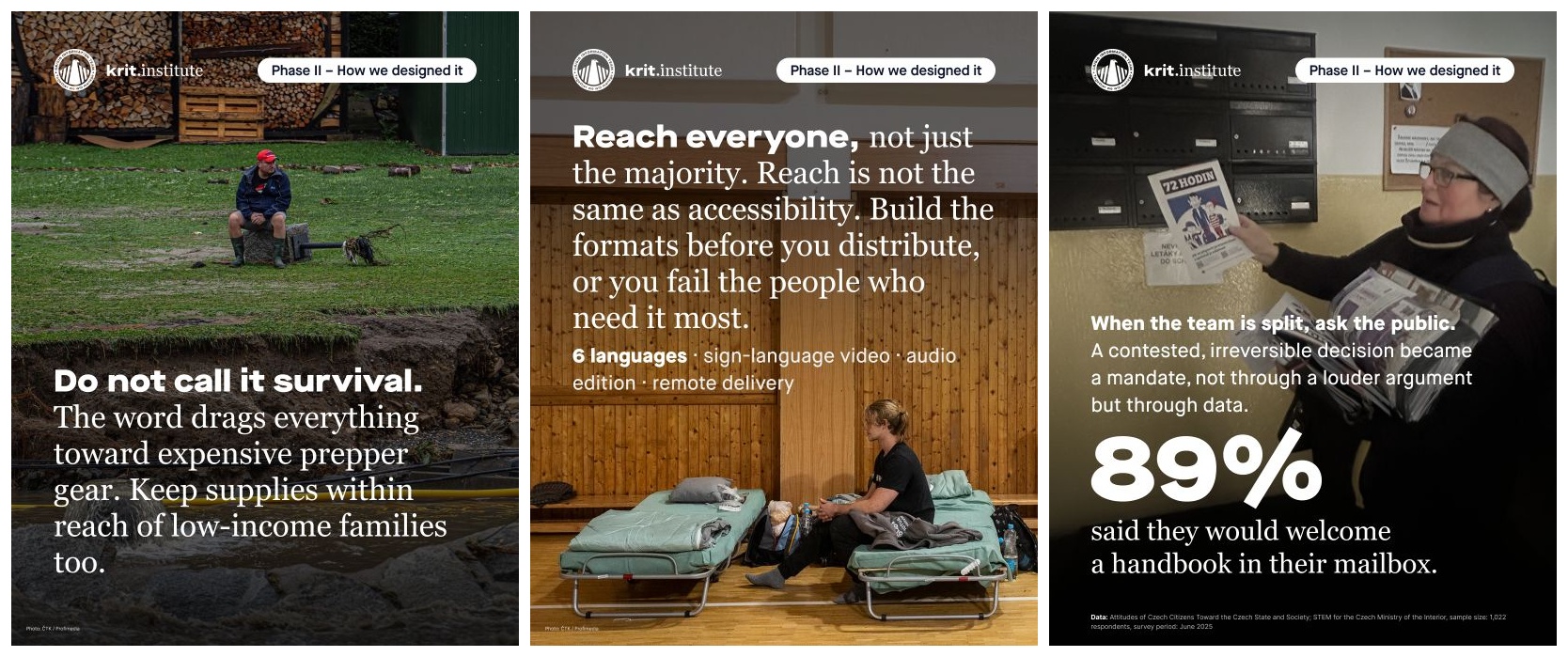
Avoid words like "survival" or "survival guide" at all costs. The shortcut is tempting for media and the public alike, and we should have pushed back harder. The moment the topic shifts to survival, it drifts toward expensive specialist gear and the logic of the lone individual hiding from the world. That is the opposite of what this is about. It is about getting through the first hours so emergency services can focus on the most vulnerable people. And keep it affordable: the supplies you recommend must be within reach of low-income families, too. Our public debate, tellingly, fixated on whether an expensive water filter was missing. It was left out on purpose.
Prepare vulnerable groups before the mailing arrives
The topic unsettles some people, and we planned for that. Before the handbook reached letterboxes, we contacted more than 600 organizations working with vulnerable populations, providing tailored messaging, FAQs, and guidance on explaining the handbook and minimizing anxiety. The payoff showed in the data: only 15% reported any worry, compared with 39% in campaigns elsewhere.
Account for everyone you want to reach
Reach is not the same as accessibility. The handbook was published in Czech, English, Ukrainian, Vietnamese, Spanish, and Mongolian, in a sign-language video, and in an audio version for the visually impaired, and the postal service carried it to remote areas. A blanket campaign fails precisely the groups that need preparedness most, unless you build the formats in advance.
When the team is split, ask the public
Behind the scenes, mailing a physical handbook to every household was genuinely contested. There was no internal consensus: it was expensive, irreversible, and exposed. What broke the deadlock was not a louder argument but data. We simply asked people, and 89% said they would welcome a handbook in their mailbox. That turned a risky bet into a mandate, and gave us the confidence and the legitimacy to go ahead. When your own team cannot agree, the public can often settle it for you.
Soft-launch before you commit to the irreversible
We launched online in the summer, on purpose, months before a single handbook hit a letterbox. Even after 120-plus experts and 68 organizations had reviewed the content, we still wanted a real public reaction. The digital-only soft launch allowed us to identify gaps and refine the message before mass printing. Test on a small stage before you commit to the one you cannot take back.
What changed, and what didn't
The mailing is a story in itself, and it pays for itself
Physical delivery of 5.2 million handbooks to households is an event. It generated media coverage, social media debate, and even its own Wikipedia entry, none of which an online campaign can replicate. And it was remarkably cheap for the reach: the entire project, from content to distribution, cost about EUR 0.19 per household. No other channel reliably reaches every household at once. Plan distribution as a communication moment, not as logistics.
Reach was real: 83% paid attention
The handbook landed. 83% of recipients paid attention to it, 66% kept it at home, and 55%, roughly 2.6 million people, rated it positively. 43% said they learned something new. For a first-ever national handbook, that is a foundation, not a footnote.
Measure emotions, not just knowledge
Knowledge tells only half the story. Track how people feel, because emotion drives the next step, and the ranking matters more than any single number. When we asked what the handbook stirred up, the top responses were a sense of having learned something useful, then personal responsibility, then the wish to be better protected, then curiosity. Worry came far down the list, and anger almost at the bottom. The mix that defines your campaign is not the one anyone shouts loudest; it is the one that quietly tops the list.
Do not mistake the loud minority for the public
If you only read the headlines and the comment sections, you would swear the whole country was burning the handbook or keeping it next to the toilet. The reality was elsewhere. In our representative survey, only 4% reported annoyance or anger, the very emotion the online noise made look dominant. The social media prism theory is real: the platforms hand a megaphone to the angriest few and hide the quiet majority who simply read the thing and kept it. Online noise is a signal of polarization, not proof of what people think. Mild controversy is not failure either: it carries the topic to people who would otherwise never hear it. Do not let it put you off, and do not let it steer you.
Expect politicization, especially before an election
We distributed after the parliamentary elections, but the campaign still ran in a pre-election climate, and part of the public read it as a political project of the outgoing government. That perception did not fully fade even after the vote. In a polarized society, assume politicization will dent your reach, and treat radical transparency, on cost above all, as your best defense.
Knowledge moved, attitudes moved, behavior did not
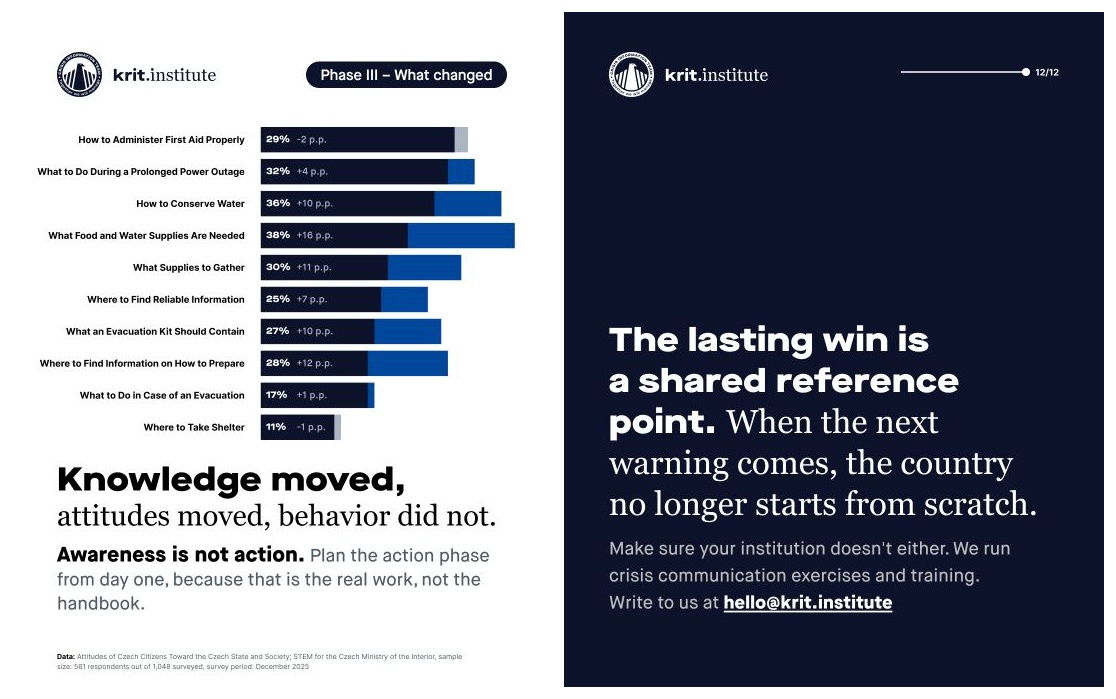
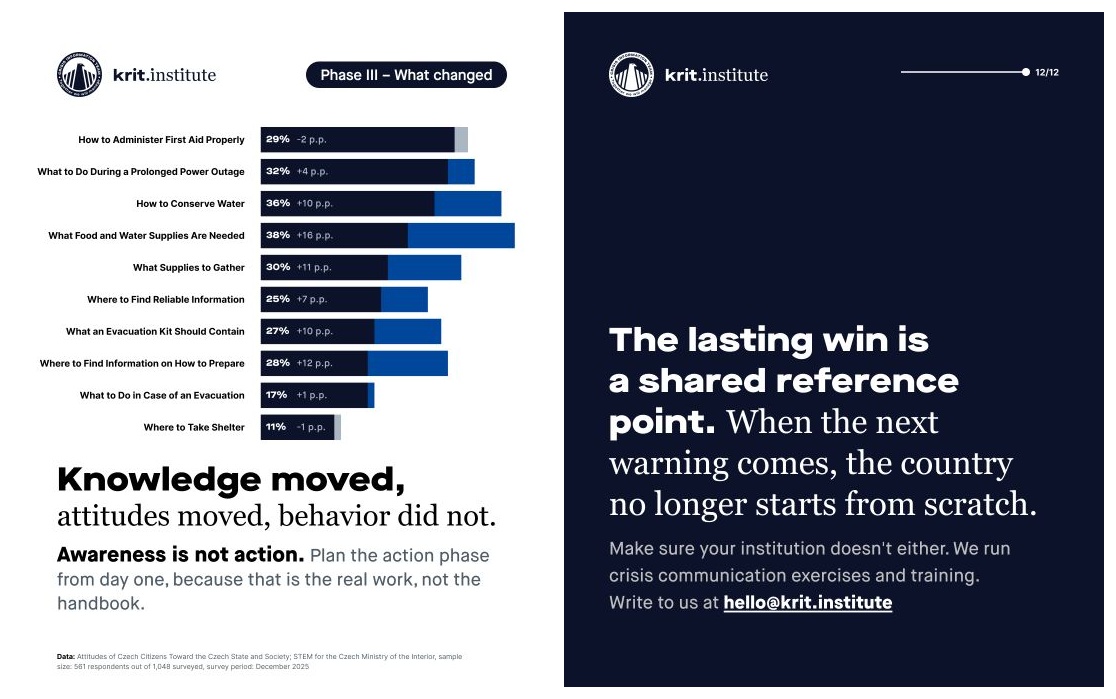
Here is the honest result. Knowledge rose across every measured area, awareness of needed supplies from 22% to 38%. Attitudes shifted too: personal responsibility climbed from 67% to 77%, and 86% now believe preparedness helps them cope. But the share of households actively preparing stayed at 27%, unchanged. Awareness is not action, and one campaign will not close that gap. Plan for the action phase from the very start, because that is the real work, not the handbook.
The lasting win is a shared reference point
The deepest change is one no single survey captures. Before this campaign, when the 2024 floods hit, advice was fragmented: every outlet gave a different version of what belonged in an evacuation bag. Now there is one source, agreed with rescuers, universities, ministries, and NGOs, that media and officials can point to. A crisis remains the strongest trigger for behavior change, and you cannot manufacture one. But when the next warning comes, the country no longer starts from scratch. That higher starting line is what a campaign like this is really for.
What comes next
From a shared reference point to shared security
The campaign did what one-way communication from the state can do: it put one trusted source into 5.2 million letterboxes and moved knowledge measurably. It cannot do the next part. Behavior changes when people stop being recipients of protection and become partners in it, when preparedness is something citizens, municipalities and employers do together with the state, not something the state performs for an audience. We call this shared security. The handbook was never the goal. It was the invitation.
The next mile is local
A national mailing creates a common language. A municipality gives people a reason to speak it. When the 2024 floods hit, municipal offices were where citizens turned for concrete instructions on what to do, and people rated them on par with the army, far ahead of the central government. Mayors know their own risks: which river rises, which road closes, how long the last blackout took. And they know they are not ready. In our survey of flood-affected municipalities, 87% wanted crisis communication training, while only a third had a detailed communication plan when the water came. The handbook's advice becomes real the moment a town tests it, in a local exercise, a school drill, a community preparedness day. The demand is there, on both sides. What is missing is someone to connect them.
Employers reach people the state cannot
The workplace is where adults actually listen. It has trust, routine and infrastructure that no government campaign can rent: onboarding, safety trainings, internal channels. And employers have their own stake, because business continuity and household preparedness are the same problem seen from two sides. An employee whose family can manage the first 72 hours is an employee who can show up when the company needs them most. Firms that treat preparedness as part of taking care of their people will be the ones that keep running while others improvise.
Repeat, or it fades
Sweden has handed its citizens a handbook for 80 years. We have done it once. A single campaign builds a starting line; only rhythm builds a culture. That means planning the second wave before the applause for the first one dies down, and it means giving preparedness an owner that outlives one government, one budget cycle, one org chart. Institutions change faster than societies do. The work has to be built to survive its own authors. Ours now continues outside government, in an independent institute working with municipalities, schools and employers on exactly this next phase.
These lessons are based on the work of the Strategic Communications Department of the Czech Ministry of the Interior, with information-space analysis by Jonáš Syrovátka, prepared by KRIT, the Institute for Crisis Communication.
Material authored by: Jaroslav Valůch & Jan Patawa. Contact: jaroslav.valuch@krit.institute.